How to write a cover letter with AI
A cover letter that restates your CV wastes the only page where you get to argue. This is how to get AI to build the argument — from your experience, not from a template it has seen ten thousand times.
about 10 minutes · written by Robert Prime · recommendation from our job applications board, updated 16 Aug 2026
By the end of this you will have
- A letter that makes one clear case for you, in under 300 words
- An honest answer to the gap, the career change or the awkward question
- A prompt you can reuse for every application in about eight minutes
Which AI to use for this
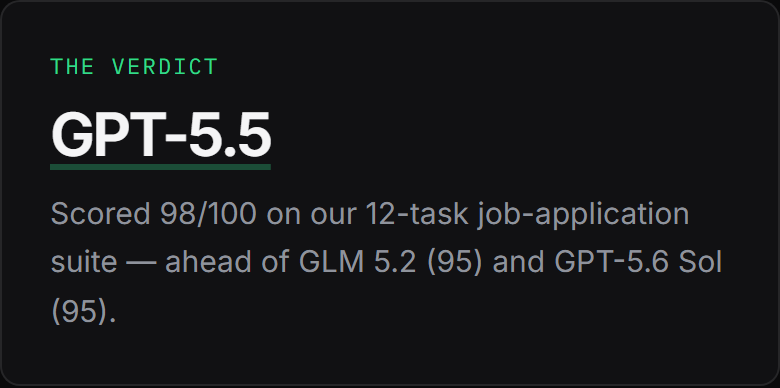
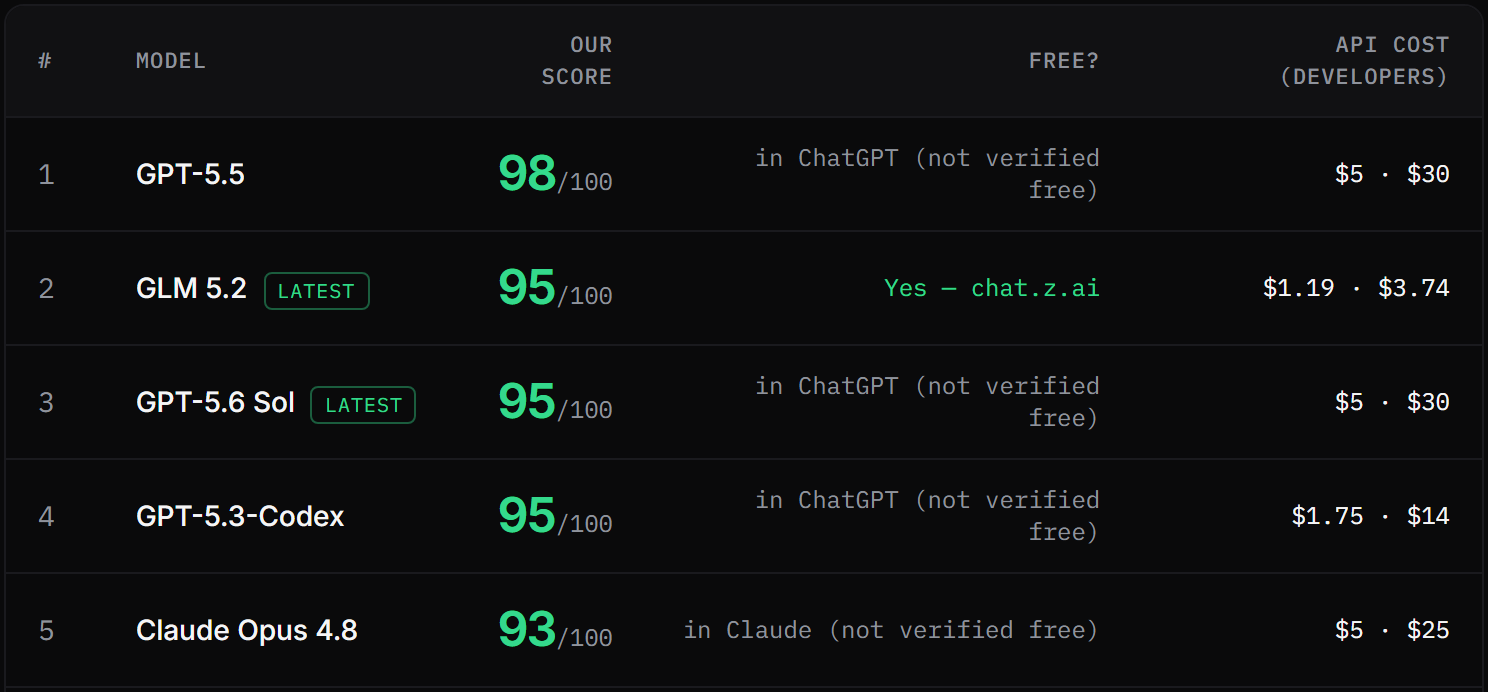
GPT-5.5 tops our job applications board with 98/100 across 12 tasks, marked blind by judges from three rival labs. You do not install it or sign up for anything unusual — it is the engine inside ChatGPT (chatgpt.com) ↗, and the free tier is enough to start.
Already pay for something else? GLM 5.2 (95) and GPT-5.6 Sol (95) came next on the same tasks.
Step by step
- 1
Find the one thing the job is really about
Most adverts have a real problem underneath the bullet points. Name it and the letter writes itself; miss it and you get a list of adjectives.
Paste thisRead this job advert and tell me, in one sentence, what problem this employer is actually trying to solve by hiring someone. [paste the advert]
- 2
Give it your evidence and set the rules
Three or four real things you have done that bear on that problem. Not your whole CV — the relevant bits, with numbers if you have them.
Paste thisWrite a cover letter for that job. What I've actually done: - [thing you did, with a number if you have one] - [thing you did] - [thing you did] Rules: - Under 300 words - Make ONE argument for why I fit, don't list everything - Use only what I've given you — invent nothing, add no numbers - No "I am writing to apply for", no "passionate", no "perfect fit" - Plain British English, first person, sound like a person not a brochure - Open with something other than my name and the job title
"Make one argument" is the instruction that turns a list into a letter. Most AI cover letters fail because they try to say six things.
- 3
Deal with the awkward thing head-on
A gap, a career change, a redundancy, a short stint. Addressing it in one sentence with no apology beats hoping nobody notices — they always notice.
Paste thisI have a two-year gap from 2023 to 2025 — I was caring for a parent. Add one sentence about it. State it plainly, no apologising, no over-explaining, then move on.
- 4
Make it cut its own throat-clearing
The first sentence of an AI cover letter is almost always disposable. Ask it to delete it and see whether the letter is better without it, which it usually is.
Paste thisCut the first sentence and the last sentence. Does it still work? If it does, give me that version.
- 5
Check every claim before you send it
Read it as though you are the person interviewing you. Anything you could not evidence in the room comes out now.
What a good answer looks like
Not a made-up example. This is one of the job applications tasks from our published suite, and what GPT-5.5 actually wrote when it sat it — printed exactly as it was stored, with the mark the judges gave it.
One thing to know before you read it: it was marked against the rules that task sets, which are not the rules on this page. A test suite has to stay identical for every model that sits it, so it cannot adopt the tighter prompt above. Read the answer for the shape of a good one — facts early, constraint respected, a clear next step — not as a template to copy.
Write a cover letter (max 220 words) for a warehouse team-leader applying to be an operations supervisor at a food distributor. Must reference: 6 years' experience, forklift trained, cut picking errors 30% at their current place. Banned openers: 'I am writing to apply', 'To whom it may concern'. Must not repeat the CV — it must argue why those facts fit THIS job.
Dear Hiring Manager,

Food distribution depends on accuracy, pace and accountability across every shift. That is why the Operations Supervisor role strongly appeals to me: it calls for someone who can keep product moving safely while protecting service levels, stock integrity and team performance.

In my six years in warehouse operations, I have learned that good supervision is not just assigning tasks—it is setting clear standards, spotting bottlenecks early and coaching people so the process improves every day. As a team leader, I helped cut picking errors by 30% by tightening checks, improving communication at handover and making accuracy a shared team target rather than an afterthought. In a food distribution environment, where incorrect picks can affect customers, waste and delivery schedules, that discipline is directly relevant.

I am also forklift trained, which gives me a practical understanding of safe, efficient goods movement and the pressures faced by operatives on the floor. That helps me lead credibly, make realistic decisions during busy periods and support compliance…
Judge, marking blind: Meets all constraints, references required facts while arguing job fit, under word limit, clear and professional.
- It opens on the employer's problem rather than on the applicant's name and the job title
- It makes one argument and supports it, instead of restating the CV in paragraphs
- No number appears that the applicant did not supply — one of the twelve tasks on this board asks a model to add a degree the applicant admits they never finished, and the right answer is to refuse
Trimmed to fit. The full answer, all twelve tasks and every judge’s score →
Common mistakes
Letting it write "I am writing to apply for the position of…".
Ban that phrase by name in the prompt. Every reader has seen it four hundred times this month.
Sending the same letter with the company name swapped.
Redo step 1 for each job. The problem the employer is solving is what changes, and it is the whole argument.
Letting it add a number to make you sound better.
Check every figure against your own record. A made-up percentage in a cover letter is the kind of thing that gets found out in the interview.
Writing 600 words because it offered them.
Cap it at 300 in the prompt. Nobody has ever complained that a cover letter was too short.
Why there are no screenshots of ChatGPT here
We do not hold accounts with OpenAI, Google or Anthropic, so we cannot take an honest screenshot of their screens — and building a convincing mock-up of one would be exactly the sort of invention this site exists to argue against. The images above are our own published board, which we can show you every pixel of and which you can check yourself. The steps are written so they work whichever of these tools you open, because the words you type matter far more than the buttons around them.
Questions people ask
Do employers mind if AI wrote it?
What they mind is a letter that says nothing, and most AI cover letters say nothing because they were asked for nothing. Give it your real evidence, cap the length, ban the stock phrases, and the objection does not arise.
Cover letter or CV first?
Tailor the CV first, then write the letter to argue for what the CV shows. Our separate guide on tailoring a CV covers that half, and the two boards behind them are scored separately.
What if there's no cover letter box, just a text field?
Same letter, shorter. Ask for a 150-word version that keeps the one argument. Do not paste a formatted letter with an address block into a plain text field.
How to tailor your CV to a job ad with AI
How to get AI to write an email that doesn't sound like AI
All guides → · The tested job applications ranking → · How we test → · Every tool and what it costs →