How to turn messy notes into revision flashcards
Most AI flashcards are useless because they tell you the answer inside the question. Getting good ones is a matter of three rules you state up front — and this works just as well for a professional exam as for GCSEs.
about 10 minutes · written by Robert Prime · recommendation from our flashcards board, updated 16 Aug 2026
By the end of this you will have
- A set of cards where the front genuinely makes you retrieve something
- Cards built only from your own notes, with no invented facts smuggled in
- A format you can paste straight into Anki, Quizlet or a printed sheet
Which AI to use for this
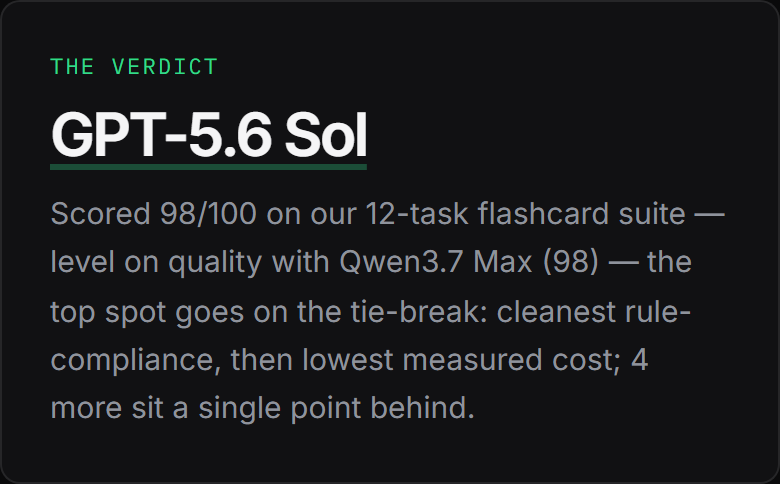
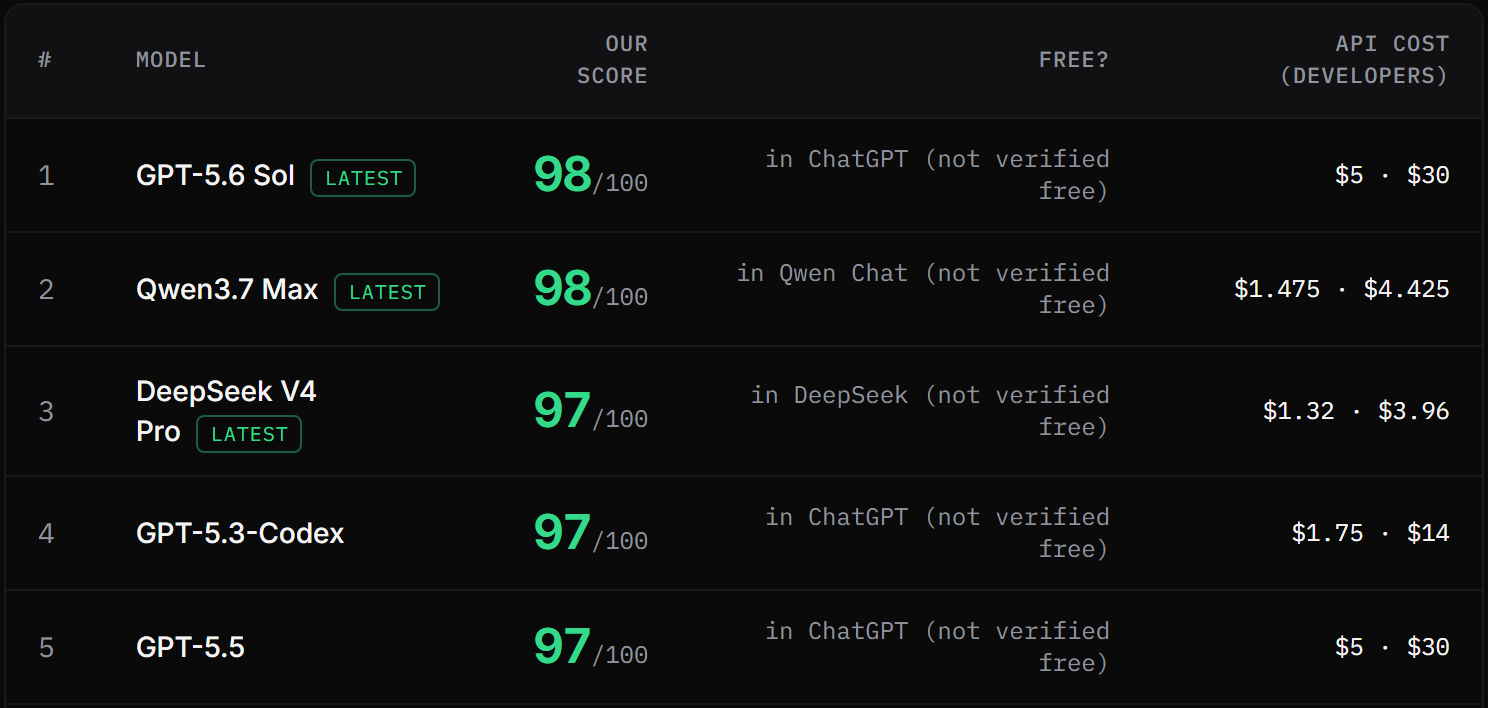
GPT-5.6 Sol tops our flashcards board with 98/100 across 12 tasks, marked blind by judges from three rival labs. You do not install it or sign up for anything unusual — it is the engine inside ChatGPT (chatgpt.com) ↗, and the free tier is enough to start.
Already pay for something else? Qwen3.7 Max (98) and DeepSeek V4 Pro (97) came next on the same tasks. 6 of the 19 we tested finished within a single point of the top, so the steps below matter more than which of them you open.
Step by step
- 1
Get your notes into one block
Bullet points, half sentences and your own shorthand are all fine — messy is what this is for. What matters is that everything you want tested is in the text you paste.
- 2
Set the three rules, then paste the notes
One fact per card, no giveaways in the question, and nothing that is not in your notes. Those three rules are the difference between cards you can revise from and cards you will delete.
Paste thisMake flashcards from the notes below. Rules: - One testable fact per card - The question must not contain the answer or an obvious clue - Use ONLY facts that appear in my notes — invent nothing - If a note is too vague to test, list it under "Needs checking" instead of guessing - Format: Question | Answer, one per line, no numbering Notes: [paste your notes here]
The "Needs checking" line is the important one. It gives the AI somewhere honest to put the things it does not know, so it stops filling gaps with plausible inventions.
- 3
Ask for cloze cards where they fit
A cloze card is a sentence with the important bit blanked out. They are excellent for definitions and dates, and terrible when the AI blanks out a filler word instead of the fact.
Paste thisNow turn the definitions into cloze cards. Blank out the term being defined, never a filler word like "the" or "important". One blank per card. Format: sentence with [...] | the missing words
- 4
Make it test you, not remind you
Recall cards are the floor. The cards that actually move a grade give you a fresh situation and ask you to apply the thing.
Paste thisAdd 5 application cards: give me a short new example or a number I haven't seen, and ask what happens or what the answer is. Don't repeat the wording from my notes.
- 5
Check ten of them against your notes
Not all of them — ten. If all ten trace back to something you actually wrote, the set is sound. If one does not, ask for the set again with the invented card named, and it will tighten up the rest too.
What a good answer looks like
Not a made-up example. This is one of the flashcards tasks from our published suite, and what GPT-5.6 Sol actually wrote when it sat it — printed exactly as it was stored, with the mark the judges gave it.
One thing to know before you read it: it was marked against the rules that task sets, which are not the rules on this page. A test suite has to stay identical for every model that sits it, so it cannot adopt the tighter prompt above. Read the answer for the shape of a good one — facts early, constraint respected, a clear next step — not as a template to copy.
From this passage, write exactly 6 flashcards as 'Q:' and 'A:' lines. Questions must be answerable from memory without the passage; answers max 15 words each. Passage: 'The heart has four chambers. The right side pumps deoxygenated blood to the lungs; the left side pumps oxygenated blood to the body. The left ventricle has the thickest wall because it pumps at the highest pressure. Valves prevent backflow.'
Q: How many chambers does the heart have?
A: Four.

Q: What type of blood does the right side of the heart pump?
A: Deoxygenated blood.

Q: Where does the right side of the heart pump blood?
A: To the lungs.

Q: Where does the left side of the heart pump oxygenated blood?
A: To the body.

Q: Why does the left ventricle have the thickest wall?
A: It pumps blood at the highest pressure.

Q: What is the function of heart valves?
A: They prevent blood from flowing backward.
Judge, marking blind: The response perfectly follows all instructions, providing exactly 6 well-formulated flashcards in the requested format. The questions are clear, and all answers are accurate and well under the 15-word limit.
- Each front asks for one thing, so you either know it or you do not — no half-credit
- The answers do not appear anywhere in the questions, which is the failure that makes most generated card sets worthless
- Nothing appears on a card that was not in the passage it was given, which is exactly what you need when the source is your own revision notes
Common mistakes
Asking for "flashcards on photosynthesis".
That gets you the internet's average flashcards, which will not match your syllabus. Paste your notes and say "only from these".
Asking for 100 cards.
Ask for 20. Quality collapses as the number climbs, and you will not revise 100 cards anyway. Do another 20 tomorrow from the next section.
Leaving a card that gives away its own answer.
Delete it or ask for it again. "Why is the mitochondria called the powerhouse of the cell?" tests nothing at all.
Trusting cards on a subject your notes did not cover.
If the AI filled a gap, it filled it from memory, and its memory is not your syllabus. Anything you cannot trace to your own notes gets checked before you learn it.
Why there are no screenshots of ChatGPT here
We do not hold accounts with OpenAI, Google or Anthropic, so we cannot take an honest screenshot of their screens — and building a convincing mock-up of one would be exactly the sort of invention this site exists to argue against. The images above are our own published board, which we can show you every pixel of and which you can check yourself. The steps are written so they work whichever of these tools you open, because the words you type matter far more than the buttons around them.
Questions people ask
Can I import these into Anki or Quizlet?
Yes. Ask for "Question | Answer, one per line" as above, then paste into Anki's import box choosing the pipe as the separator, or into Quizlet's Import screen. Ask for a comma or a tab instead if your text contains pipes.
How many cards should one revision session make?
Twenty from one topic beats a hundred from a whole module. Cards get worse the more you demand at once, and a set you finish is worth more than a set you abandon.
Will it write my essay too?
It will, and that is not what this is. One of the tasks on our flashcards board pastes in an essay question and asks the AI to write something the student can hand in — the models that do it lose marks. Cards to revise from are yours; work you hand in has to be.
How to summarise a long document with AI
How to use AI in Excel and Google Sheets
All guides → · The tested flashcards ranking → · How we test → · Every tool and what it costs →