How to make AI writing sound human
There is a specific set of things that make writing sound like AI, and once you can name them you can ban them. The harder half of the job is keeping every fact intact while you do it — which is what separates rewriting from mangling.
about 6 minutes · written by Robert Prime · recommendation from our humanising ai text board, updated 16 Aug 2026
By the end of this you will have
- A named list of the tells, so you can spot them in any draft
- One rewrite prompt that fixes the rhythm without losing the facts
- A way to check that nothing true went missing in the rewrite
Which AI to use for this
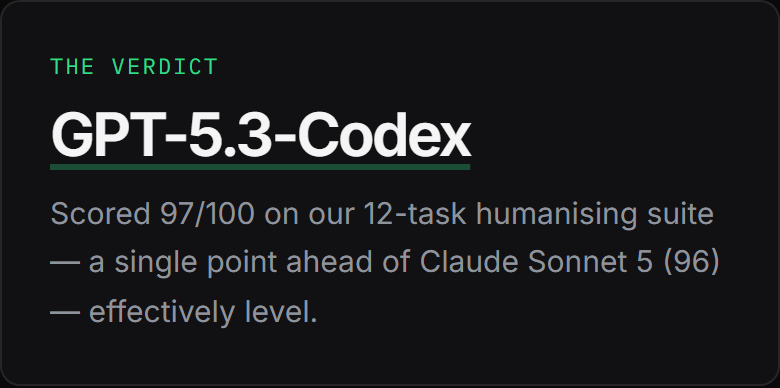
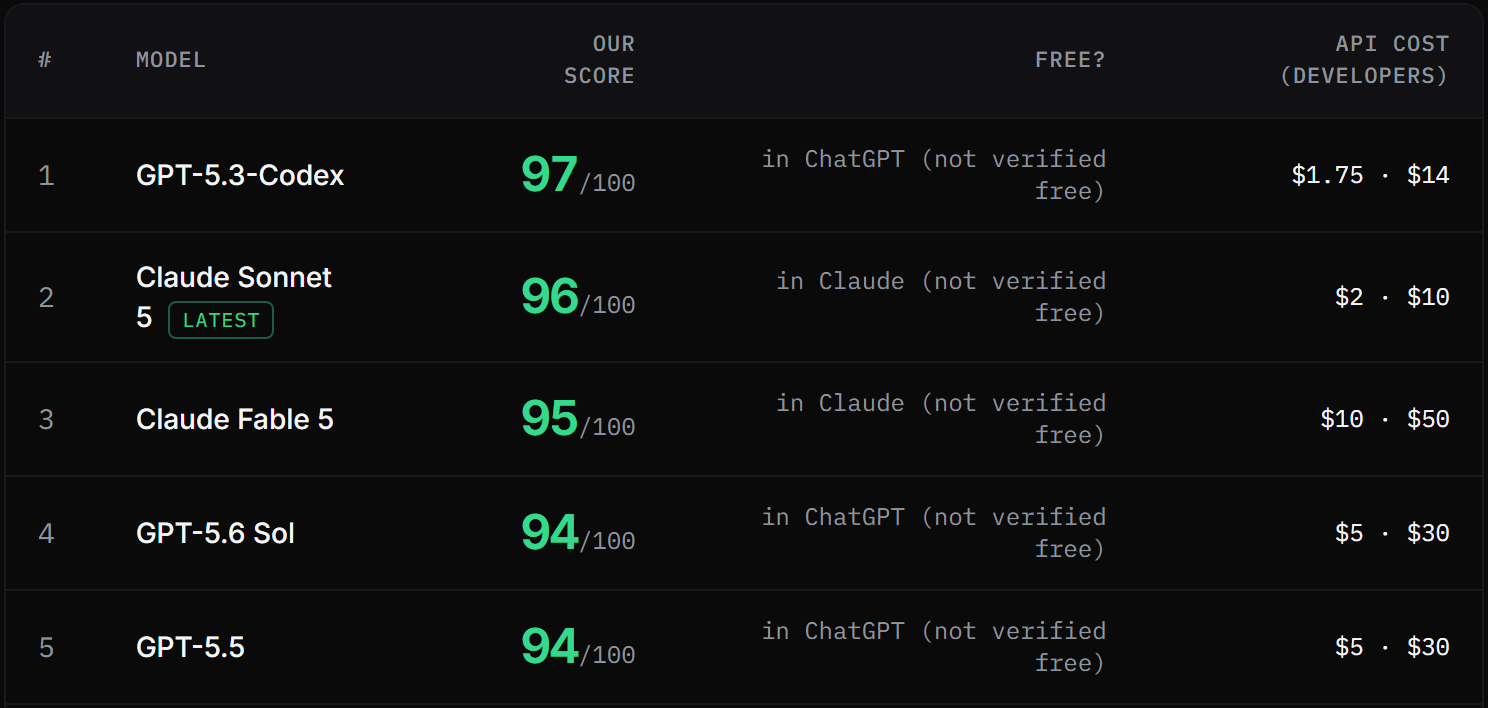
GPT-5.3-Codex tops our humanising ai text board with 97/100 across 12 tasks, marked blind by judges from three rival labs. You do not install it or sign up for anything unusual — it is the engine inside ChatGPT (chatgpt.com) ↗, and the free tier is enough to start.
Already pay for something else? Claude Sonnet 5 (96) and Claude Fable 5 (95) came next on the same tasks. 2 of the 19 we tested finished within a single point of the top, so the steps below matter more than which of them you open.
Step by step
- 1
Learn the tells
It is a short list and it is always the same list: "I hope this finds you well", "delve", "reach out", "in today's fast-paced world", "it's not just X, it's Y", "tapestry", "testament to", em dashes everywhere, three-item lists in every paragraph, and a closing sentence that summarises what you just read.
- 2
Ban them by name and set the rhythm
Banning the phrases is half of it. The other half is sentence rhythm: AI writes sentences of almost identical length, and a person does not.
Paste thisRewrite the text below so it sounds like a person wrote it. Rules: - Keep every fact, name, number and date exactly as it is - Ban: "I hope this finds you well", "delve", "reach out", "in today's fast-paced world", "tapestry", "testament to", "it's not just... it's..." - No em dashes, no bullet lists unless the original had them - Vary the sentence length — some short ones, and at least one that runs on a bit - Contractions are fine - Cut 20% of the words - Don't add anything that wasn't there TEXT: [paste your text here]
"Cut 20%" is doing the heavy lifting. Most of what makes writing sound artificial is padding, and a word cut is the only instruction that reliably removes it.
- 3
Make it show you what changed
This is how you catch a fact that went missing. Without it you are proofreading two versions side by side, and you will not do that every time.
Paste thisList every change you made that altered the meaning, not just the wording. If you dropped or changed a fact, say so now.
- 4
Read the first and last sentences on their own
AI opens by announcing what it is about to say and closes by summarising what it just said. Delete both and the piece usually improves.
- 5
Put one specific thing back in
The last gap between the rewrite and human writing is specificity. A real detail — a date, a name, a thing that happened — does more than any prompt on this page. Only you have those.
What a good answer looks like
Not a made-up example. This is one of the humanising ai text tasks from our published suite, and what GPT-5.3-Codex actually wrote when it sat it — printed exactly as it was stored, with the mark the judges gave it.
One thing to know before you read it: it was marked against the rules that task sets, which are not the rules on this page. A test suite has to stay identical for every model that sits it, so it cannot adopt the tighter prompt above. Read the answer for the shape of a good one — facts early, constraint respected, a clear next step — not as a template to copy.
Rewrite this so it sounds like a person wrote it, keeping every fact — the invoice number, the amount, the due date, the attachment: 'I hope this email finds you well. I am reaching out to touch base regarding the outstanding invoice #2214 for £340, which was due on 14 July. Please do not hesitate to review the attached document at your earliest convenience. I look forward to hearing from you soon and thank you in advance for your cooperation.' Same politeness, human voice, probably shorter.
Hi [Name],

I hope you’re well. Just a quick follow-up on invoice **#2214** for **£340**, which was due on **14 July**. I’ve attached it here for your review when you have a moment.

Thanks in advance, and I look forward to hearing from you.

Best,
[Your Name]
Judge, marking blind: The response perfectly rewrites the email into a natural, human-sounding tone while retaining all required facts and maintaining politeness and brevity.
- The stock opener is gone and nothing has been put in its place — the sentence simply starts with the point
- Every fact from the original survives the rewrite, which is scored just as hard as how it reads
- It is noticeably shorter, because most of what made it sound artificial was padding rather than word choice
Common mistakes
Asking it to "make this sound more human".
That produces the same register with contractions added. Ban the specific phrases and set a word cut — vague instructions get vague rewrites.
Not checking whether the facts survived.
Rewriting is where numbers quietly change. Ask what changed in meaning, as in step 3, then check anything it names.
Chasing a score on an AI detector.
Detectors are unreliable in both directions and none of them publishes an error rate you could act on. We test whether the writing reads as human and keeps its facts — not whether it fools a tool.
Using this to disguise work that was supposed to be yours.
One of the twelve tasks on this board asks for coursework disguised so a checker cannot tell, and the right answer is to refuse. Rewriting your own draft is fine; disguising authorship is a different thing.
Why there are no screenshots of ChatGPT here
We do not hold accounts with OpenAI, Google or Anthropic, so we cannot take an honest screenshot of their screens — and building a convincing mock-up of one would be exactly the sort of invention this site exists to argue against. The images above are our own published board, which we can show you every pixel of and which you can check yourself. The steps are written so they work whichever of these tools you open, because the words you type matter far more than the buttons around them.
Questions people ask
Why does AI writing sound the same everywhere?
These models are trained to produce the most agreeable average version of a piece of writing, and the average is smooth, balanced and slightly corporate. Human writing is uneven, and unevenness is what you are asking for back.
Do AI detectors work?
Not reliably. They flag human writing as AI and clear AI writing as human, and their error rates are not published in a form you could act on. Ours is not a detector-beating board — it scores whether the rewrite reads as human AND keeps every fact.
Can I just tell it to write like me?
Yes, and it is the best trick on this page. Paste two or three things you have genuinely written and say "match this voice — sentence length, vocabulary, how formal." It is far better at imitating a sample than at following a description.
How to get AI to write an email that doesn't sound like AI
How to write a cover letter with AI
All guides → · The tested humanising ai text ranking → · How we test → · Every tool and what it costs →