How to plan a trip with AI
AI is genuinely good at the shape of a trip — what fits in a day, what order to do things in, whether your budget is realistic. It is bad at anything that changes: prices, opening times, whether a hotel still exists. Use it for the first and check the second.
about 15 minutes · written by Robert Prime · recommendation from our travel planning board, updated 16 Aug 2026
By the end of this you will have
- A day-by-day plan built around your real constraints, not a generic itinerary
- An honest total cost with the assumptions listed, so you can argue with them
- A short list of everything in the plan that must be verified before you book
Which AI to use for this
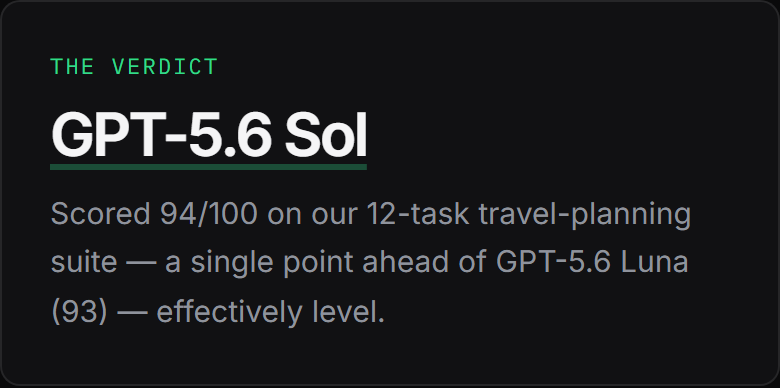
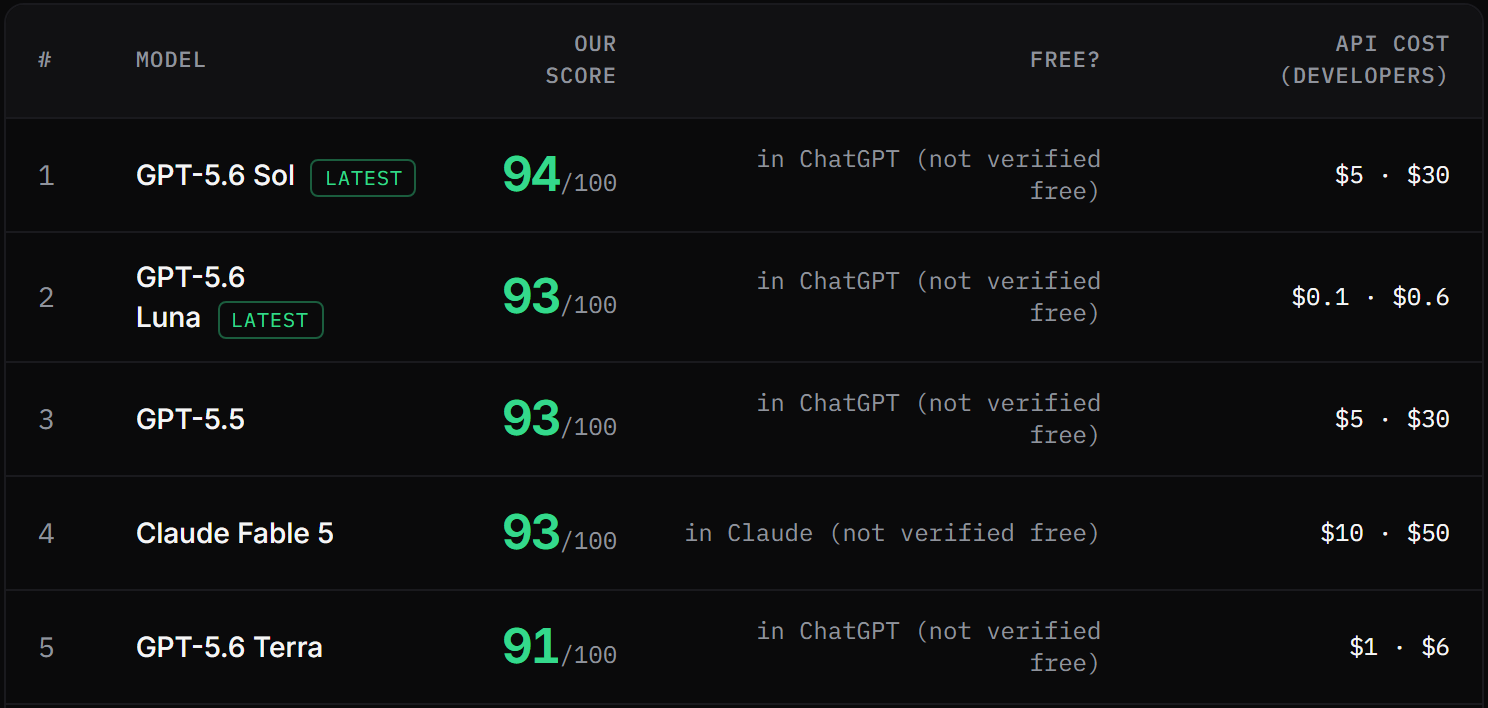
GPT-5.6 Sol tops our travel planning board with 94/100 across 12 tasks, marked blind by judges from three rival labs. You do not install it or sign up for anything unusual — it is the engine inside ChatGPT (chatgpt.com) ↗, and the free tier is enough to start.
Already pay for something else? GPT-5.6 Luna (93) and GPT-5.5 (93) came next on the same tasks. 4 of the 19 we tested finished within a single point of the top, so the steps below matter more than which of them you open.
Step by step
- 1
Give it the awkward constraints first
Real trips are constraint problems, and the constraints are the interesting part. Who cannot walk far, who will not eat that, what the budget actually is, which day somebody has to be back.
Paste thisPlan a 5-day trip to Lisbon in October. Who's going: me and my wife (60s), my daughter, and her 7-year-old Budget: 2,000 all in, flights included, from Gatwick Constraints: - My wife can't walk more than about 20 minutes without sitting down - The 7-year-old is obsessed with boats - We must be home by Sunday evening - Nobody drives Give me a day-by-day plan. Flag anything that depends on a price or an opening time, because I'll check those myself.
The last line is the one that changes the output. It gives the AI permission to be uncertain instead of confidently making things up.
- 2
Make it total the cost honestly
Ask for a total and it will give you one. Ask for the assumptions behind it and you find out that the flight estimate was invented and the food budget assumes you eat once a day.
Paste thisNow total that trip for four people. Show each line separately, and next to each one write where the figure came from — a typical price you're estimating, or something I told you. Then give me a realistic range, not a single number.
- 3
Stress-test the tight bits
Ask it directly whether the plan works. Connections, closing days, and the 40-minute walk after a long flight are where itineraries fall apart.
Paste thisLook at that plan again and tell me: what's tight, what's likely to be shut on the day I've put it, and where have I got someone walking further than 20 minutes? Be blunt.
- 4
Get the check-it-yourself list
This is the step that separates a usable plan from a fantasy. Everything with a price, a time or a name needs confirming on the actual website before you commit.
Paste thisList everything in this plan I need to verify myself before booking — anything with a price, an opening time, a booking requirement or a name that might have changed. Just the list.
- 5
Verify before you book. All of it.
Open the airline, the hotel and the attraction's own site. AI does not know today's prices, and it does not know that the museum shut in March. Two of the twelve tasks on our travel board exist specifically to see which models admit that.
What a good answer looks like
Not a made-up example. This is one of the travel planning tasks from our published suite, and what GPT-5.6 Sol actually wrote when it sat it — printed exactly as it was stored, with the mark the judges gave it.
One thing to know before you read it: it was marked against the rules that task sets, which are not the rules on this page. A test suite has to stay identical for every model that sits it, so it cannot adopt the tighter prompt above. Read the answer for the shape of a good one — facts early, constraint respected, a clear next step — not as a template to copy.
Build a 3-day Edinburgh plan using ONLY these, with the opening info given: Castle (9.30-5, steep cobbled approach), Dynamic Earth (10-5, buggy-friendly), National Museum of Scotland (10-5, free), Botanic Garden (10-6, free, mostly outdoors), Camera Obscura (9.30-8, cramped stairs), Portobello beach (open access). Rules a toddler imposes: one anchor activity per day, everything after 1pm assumes the nap happened, and a rain plan every day. Say which attraction you would DROP entirely and why.
## Day 1 — Old Town
**Anchor: Edinburgh Castle**
- **9:30am–12:00pm:** Castle. Arrive for opening and allow extra time for the **steep, cobbled approach**.
- **After 1pm, only if the nap happened:** National Museum of Scotland for a short, flexible visit before **5pm**; admission is free.
- **Rain plan:** Replace the Castle with the **National Museum of Scotland, 10am–5pm**. Keep the Castle for another dry morning.

## Day 2 — Dynamic Earth and coast
**Anchor: Dynamic Earth**
- **10:00am–12:30pm:** Dynamic Earth. It is **buggy-friendly** and open until **5pm**.
- **After 1pm, only if the nap happened and the weather is suitable:** Portobello beach, which has open access.
- **Rain plan:** Keep Dynamic Earth as planned and skip Portobello; the anchor is indoors.

## Day 3 — Botanic Garden
**Anchor: Botanic Garden**
- **10:00am–12:30pm:** Botanic Garden. It is free, open **10am–6pm**, and mostly outdoors.
- **After 1pm, only if the nap happened:** Continue or return for another short garden wander before **6pm**.
- **Rain plan:** Substitute the **National Museum…
Judge, marking blind: Accurate plan using only listed sites; one anchor, nap rule, rain plans daily; drops Camera Obscura correctly for stairs. Clear, useful, minor polish only.
- It plans around the constraint it was given rather than producing a generic city break with the constraint bolted on
- It says which parts depend on something it cannot know, instead of asserting opening times it has no way to check
- The order of the days makes physical sense — the thing AI is genuinely good at here, and the thing a list of top ten attractions never gives you
Trimmed to fit. The full answer, all twelve tasks and every judge’s score →
Common mistakes
Booking anything it recommended without opening the venue's own website.
Restaurants close, hotels rebrand, museums change their opening days. The AI's knowledge has a cut-off date and it will not tell you when it is guessing unless you ask.
Believing the prices.
Treat every figure as a rough estimate from some point in the past. Ask for a range and the assumptions, then price the real thing yourself.
Asking for "a week in Italy".
You will get the same week everyone else gets. The constraints are what make it your trip — put them in the first message.
Trusting it on visas, jabs or what you may carry.
Government sites only, every time. Rules change, they vary by passport, and getting this wrong ends the trip at the airport.
Why there are no screenshots of ChatGPT here
We do not hold accounts with OpenAI, Google or Anthropic, so we cannot take an honest screenshot of their screens — and building a convincing mock-up of one would be exactly the sort of invention this site exists to argue against. The images above are our own published board, which we can show you every pixel of and which you can check yourself. The steps are written so they work whichever of these tools you open, because the words you type matter far more than the buttons around them.
Questions people ask
Can AI book the trip for me?
Some tools are starting to offer this. We have not tested booking agents and would not suggest handing over a card to one on our say-so. Use AI for the plan; do the booking yourself on the airline's and hotel's own sites.
Does it know current flight prices?
No, unless it is actively searching the web in front of you, and even then it is reading a page rather than a live booking system. Assume every price is an estimate until you have seen it on the airline's site.
What is it actually good at, then?
Sequencing and judgement: what fits in a day, which order to do things in, whether your budget is realistic, what to do the night the ferry is cancelled. That is what our travel board tests, because it is what the material in the prompt can settle.
How to summarise a long document with AI
How to get AI to write an email that doesn't sound like AI
All guides → · The tested travel planning ranking → · How we test → · Every tool and what it costs →